CBCT in Dentistry: When 3D Imaging Is Worth It
CBCT dental imaging delivers 3D views that 2D X-rays can't match. Learn when it's clinically justified, what doses are involved, and what's new.
AI-assisted, human-governed and fact-checked — how we work.
Produced with AI assistance under human editorial governance and fact-checked against the cited sources. How we work.
CBCT dental imaging gives clinicians a true three-dimensional view of teeth, jaws, and surrounding anatomy that conventional 2D radiographs simply can’t replicate. Used well, it changes treatment decisions. But it isn’t a routine substitute for periapical or panoramic films, and every decision to scan should be justified by a clear clinical question.
This guide covers how CBCT works, where it earns its place in the clinical workflow, what radiation exposure actually looks like, and what the regulatory and AI landscapes mean for your practice today. For a wider look at the imaging tools available to modern practices, see our Scanners & Imaging hub, or read our primer on digital radiography in dentistry for context on how 2D and 3D modalities compare.
How CBCT Dental Imaging Works
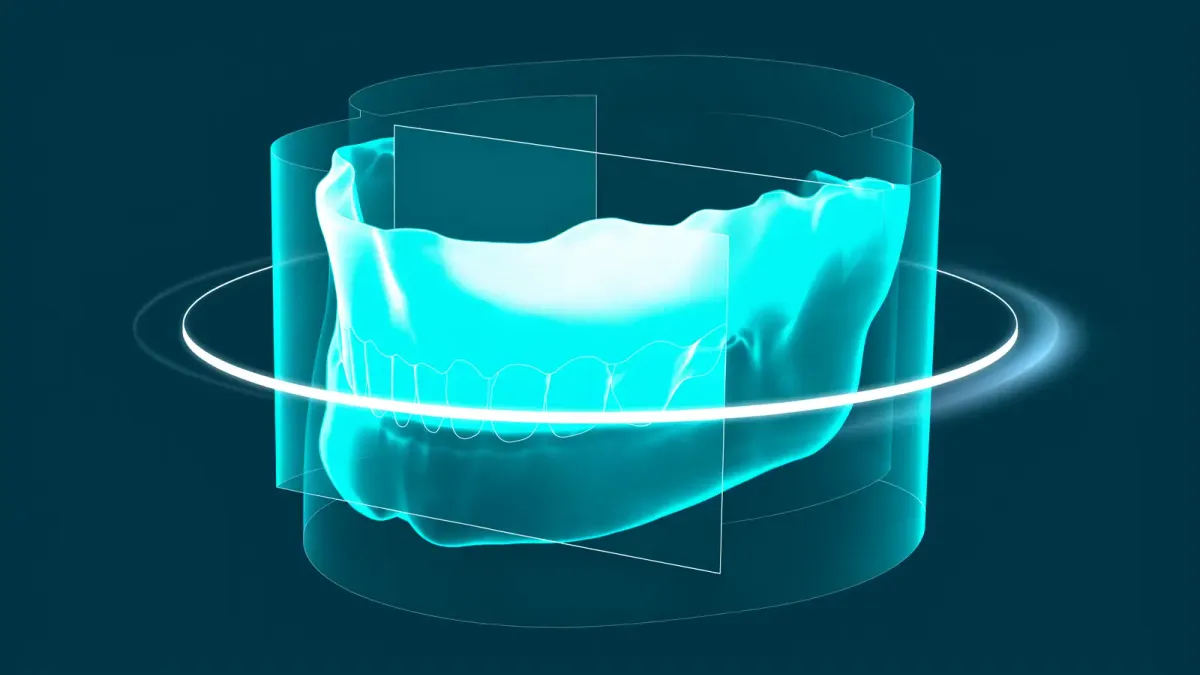
The x-ray source and a rigidly coupled flat-panel sensor rotate around the patient’s head, typically a full 360 degrees, capturing roughly 150 to 599 unique radiographic projections in a single pass. The scanning software then reconstructs those raw frames into a volumetric dataset, which you can view as axial, coronal, and sagittal slices or as a full 3D render, according to a peer-reviewed overview published in PMC.
Field of View: The Variable That Matters Most
Field of view (FOV) is the single biggest lever on both dose and resolution:
- Large FOV (> 15 cm): Full craniofacial volume; used for orthognathic surgery planning, airway assessment, TMJ evaluation.
- Medium FOV (8–15 cm): Single arch to full-jaw coverage; suits implant planning across a quadrant or more.
- Limited FOV (< 8 cm): One to four teeth; delivers the lowest dose and the highest resolution — the right choice for endodontic workups and isolated implant sites.
Matching FOV to the clinical task isn’t just good practice. It’s a core principle of radiation protection, endorsed by both the ADA and FDA.
When Is CBCT Clinically Justified?
In several well-defined scenarios, CBCT delivers diagnostic value that 2D techniques can’t match, according to peer-reviewed research.
Implant Planning
CBCT is now treated as an essential component of dental implantology. Multiplanar reconstruction and 3D bone volume rendering let clinicians evaluate bone height, width, quality, and density before a fixture goes in, which cuts down on intraoperative surprises. Third-party software uses the same DICOM data to generate surgical guides, virtual wax-ups, and printed resin models.
Endodontics
For endodontic disease, CBCT offers a stereoscopic perspective that allows accurate observation of root canal morphology, periapical status, root fractures, and resorption defects. A 2024 PMC review on CBCT in endodontic practice found it demonstrates better diagnostic efficacy than 2D imaging for detecting apical periodontitis and longitudinal root fractures. Those are exactly the cases where a missed diagnosis costs the most.
Orthodontics and Oral Surgery
Skeletal discrepancy assessment, impacted third molar proximity to the inferior alveolar nerve, complex trauma: all of these benefit from 3D data. CBCT also generates virtual cephalometric and panoramic reconstructions from a single scan, which spares the patient several separate acquisitions.
Emerging: Systemic Screening
Research presented at the IADR suggests CBCT bone-density measurements may work as an opportunistic screening tool for osteoporosis in women. It’s an area of active clinical investigation, though not yet a mainstream indication.
Radiation Dose: Putting the Numbers in Context
The average effective dose for a dental CBCT examination is roughly 100 µSv, with a published range of 18.5 to 1,073 µSv depending on FOV, protocol, and machine settings, according to a dose comparison study published in PMC. That sits well below conventional maxillofacial CT, which delivers roughly 2,000 mSv, a reduction of between 76% and 98.5%.
The operator has a few real controls here: collimating to the area of interest, selecting appropriate kVp and mA, and choosing the smallest clinically adequate FOV. The FDA regulates dental CBCT manufacturers through the Electronic Product Radiation Control provisions of the Federal Food, Drug, and Cosmetic Act, and the agency’s guidance page is a useful reference for device-specific compliance information.
Regulatory and Professional Guidelines
Back in 2012, the ADA and FDA jointly published patient-selection criteria for dental CBCT to help practitioners weigh diagnostic benefit against radiation risk. The ADA Council on Scientific Affairs has since updated its evidence-based recommendations. A 2024 JADA paper on optimizing radiation safety in dentistry reinforces the point that the ALARA principle (As Low As Reasonably Achievable), appropriate patient selection included, remains non-negotiable.
Check your state-level requirements too. Operator training and equipment quality-assurance testing vary by jurisdiction.
AI Integration: What’s Arriving Now
AI is starting to augment CBCT interpretation. Overjet’s CBCT Assist has received 510(k) clearance from the FDA, and the company, according to its own reported figures, leads the dental AI imaging field with nine FDA-cleared modules covering caries detection, periapical radiolucency, and image enhancement. Pearl follows with seven FDA-cleared modules that include CBCT segmentation. These tools are positioned as decision-support aids, not replacements for clinical judgment.
On the surgical side, the Yomi robotic arm (Neocis) uses CBCT-derived data to deliver physical guidance cues during implant placement, an early illustration of CBCT’s role as the backbone of robotic-assisted dentistry.
Where CBCT Fits in a Broader Digital Workflow
CBCT data slots naturally into digital dentistry workflows. A DICOM file from the unit can feed implant-planning software, drive surgical guide mills, and even merge with intraoral scan data for full-arch restorative planning. If you’re evaluating the intraoral scanning side of that equation, our guide to the best intraoral scanner options covers the current field in detail.
The technology isn’t without drawbacks. Acquisition cost, the need for dedicated training, beam-hardening artifacts from metal restorations, the dose itself: each argues against routine, undifferentiated use. So the clearest rule still holds. Order CBCT when the 3D information will materially change your diagnosis or treatment plan, and skip it when it won’t.
Frequently asked questions
Is CBCT safe enough for routine use in dental practice?
CBCT delivers substantially less radiation than conventional medical CT — effective doses range from 18.5 to 1,073 µSv depending on field of view and protocol, compared to roughly 2,000 mSv for maxillofacial CT. However, ADA and FDA guidelines do not support CBCT as a routine screening tool. It should be prescribed only when the expected 3D diagnostic information will materially change a clinical decision and the benefit outweighs the added radiation exposure — particularly for children and pregnant patients.
What is the difference between a large, medium, and limited FOV CBCT scan?
Field of view (FOV) defines the anatomical volume captured. Large FOV (> 15 cm) covers the full craniofacial skeleton and is used for orthognathic surgery or airway assessment. Medium FOV (8–15 cm) covers one or both arches and suits multi-site implant planning. Limited FOV (< 8 cm) covers one to four teeth and delivers the lowest dose alongside the highest resolution — making it the preferred choice for endodontic workups, isolated implant sites, or suspected root fractures.
Which clinical situations most justify ordering a CBCT dental scan?
Peer-reviewed evidence supports CBCT for implant site assessment (bone volume, density, proximity to vital structures), complex endodontic cases (missed canals, root fractures, resorption, apical periodontitis that is equivocal on periapical films), impacted teeth near critical anatomy, orthodontic skeletal assessment, and diagnosis of TMJ pathology. In each case, the key test is whether the 3D information is expected to change the treatment plan versus what 2D imaging alone would provide.
Are AI tools for CBCT analysis FDA cleared?
Yes, some are. Overjet's CBCT Assist module has received 510(k) clearance from the FDA — a fact confirmed by the FDA's clearance database. Pearl also holds FDA clearance for modules that include CBCT segmentation. These tools are designed as decision-support aids to assist clinicians in detecting and categorizing pathology; they do not replace clinical interpretation. Practices should verify current clearance status directly with vendors before deploying any AI diagnostic tool, as the regulatory landscape in this space is evolving quickly.
Sources
- 1.Cone Beam Computed Tomography: Basics and Applications in Dentistry – PMC
- 2.Clinical Benefits and Limitations of CBCT in Endodontic Practice – PMC
- 3.Comparing Radiation Doses in CBCT and Medical CT Imaging – PMC
- 4.Dental Cone-Beam Computed Tomography – FDA Official Page
- 5.Optimizing Radiation Safety in Dentistry – JADA (ADA)
The Digital Dentistry editorial team covers dental technology for practice owners, clinicians and dental labs. Our articles are produced with AI assistance under human editorial governance, fact-checked against cited primary sources, and updated as products and evidence change. See our editorial policy for how we work and how to flag a correction.