Guided Implant Surgery: A Practical Primer
Guided implant surgery explained for dental professionals: static vs. dynamic, accuracy data, workflow steps, and how to choose the right approach.
AI-assisted, human-governed and fact-checked — how we work.
Produced with AI assistance under human editorial governance and fact-checked against the cited sources. How we work.
| Attribute | Static Surgical Guide Various (in-house or lab-fabricated) | Dynamic Navigation System Various (e.g., X-Guide, Navident — verify current availability with manufacturers) |
|---|---|---|
| Price | Guide fabrication cost varies by method and whether in-house or lab-outsourced; no capital equipment beyond planning software | Capital cost for tracking hardware and software is substantially higher than static guide workflows; contact vendors for current pricing |
| Pros |
|
|
| Cons |
|
|
| Best for | Most routine single-tooth and short-span cases; practices new to guided workflows or with limited capital budgets | Complex full-arch rehabilitations, immediate-loading cases requiring plan flexibility, or practices already invested in advanced digital infrastructure |
- Price
- Guide fabrication cost varies by method and whether in-house or lab-outsourced; no capital equipment beyond planning software
- Pros
- Lower cost — no tracking hardware required
- Well-established clinical protocols
- Compatible with any operatory
- Multiple guide fabrication options (milled or 3D-printed)
- Cons
- No intraoperative plan modification
- Drill access and irrigation can be restricted by stent body
- Accuracy depends on quality of guide seating surface
- Mucosal-supported guides are prone to seating variability
- Best for
- Most routine single-tooth and short-span cases; practices new to guided workflows or with limited capital budgets
- Price
- Capital cost for tracking hardware and software is substantially higher than static guide workflows; contact vendors for current pricing
- Pros
- Real-time intraoperative plan visualisation and modification
- No physical stent required — useful in restricted-access sites
- Same-day CBCT-to-surgery workflow feasible in some setups
- Recent meta-analyses show accuracy advantage over static guides
- Cons
- Significantly higher equipment investment
- Steeper learning curve and clinical implementation challenges
- Less widely adopted — fewer published long-term studies
- Some evidence of slightly higher apical deviation in anterior teeth
- Best for
- Complex full-arch rehabilitations, immediate-loading cases requiring plan flexibility, or practices already invested in advanced digital infrastructure
Verdict: Static guides cover the majority of guided implant surgery cases cost-effectively; dynamic navigation adds value in complex, flexibility-dependent scenarios for practices with the volume and infrastructure to justify the investment.
Guided implant surgery takes a position you’ve planned on a screen and reproduces it in the mouth. Two ways to get there: a physical drilling guide, or a navigation system that tracks the handpiece live. The pitch is precision. The reality is a workflow with several moving parts, and each one can add error or take it away. This primer is for practices weighing whether that workflow is worth adopting, and if so, in which form.
What Is Guided Implant Surgery?
Strip away the marketing and the definition is simple. It’s any protocol where a preoperative digital plan steers placement instead of the surgeon’s eye and hand working alone. The standard sequence runs like this.
- CBCT acquisition — captures bone volume, density, and proximity to vital structures.
- Intraoral or model scanning — provides surface anatomy for prosthetic planning. (The capture device matters more than people expect; our guide to the best intraoral scanner options for 2026 covers the field.)
- Data merging and virtual planning — DICOM and STL files are aligned in planning software, and the clinician positions implants to satisfy both the anatomy and the eventual restoration.
- Guide fabrication or navigation setup — a physical stent gets manufactured, or a dynamic tracking system is calibrated.
- Guided placement — the guide or tracker constrains the osteotomy to the virtual plan.
None of this lives in isolation. It runs on the same scanners, software, and printers that already drive your restorative and prosthodontic work. That overlap is a big part of why it slots so naturally into a practice already doing digital dentistry.
Static vs. Dynamic: Choosing the Right Modality
Static Guided Surgery
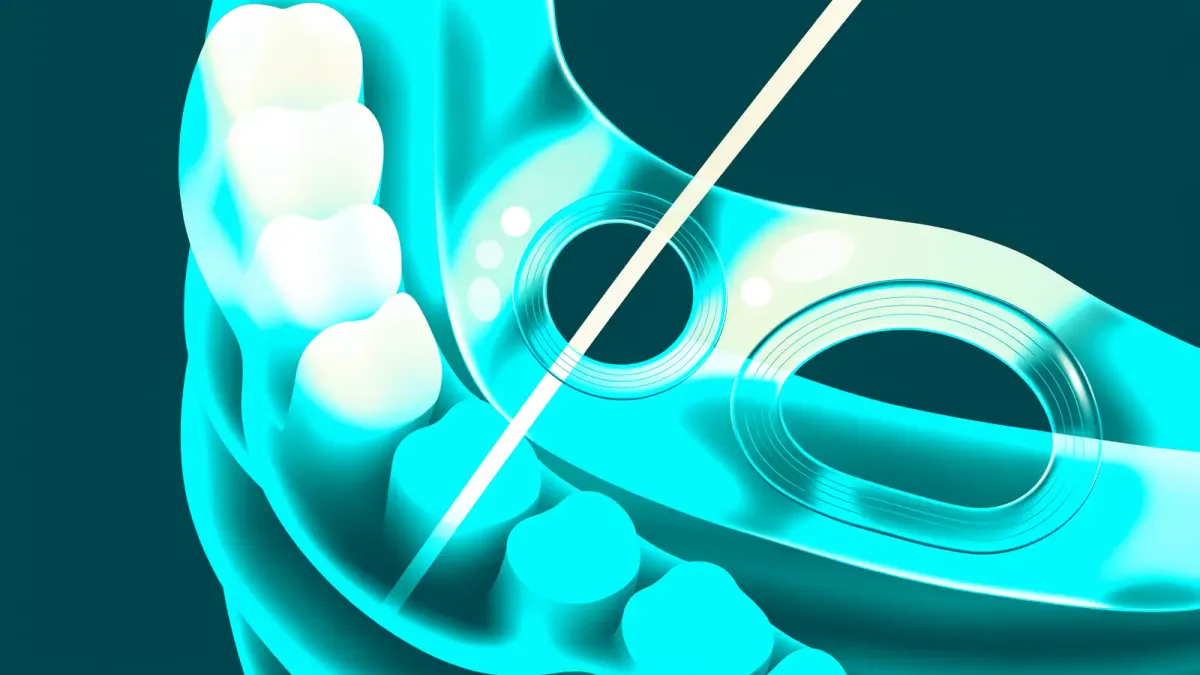
A static guide is a custom-milled or 3D-printed stent with metal sleeves that fix drill angulation and depth. You design it before surgery. Once it’s made, the plan is locked, and there’s no changing your mind mid-procedure.
That rigidity is also the appeal. Static guides cost less and need no hardware beyond the stent itself. They run on protocols clinicians have used for years, and they work in any operatory. The trade-offs are real, though. The stent body can crowd drill access and get in the way of irrigation, and seating accuracy is only ever as good as the reference surface it rests on, whether that’s tooth, mucosa, or bone.
Dynamic Guided Surgery (Navigation)
Dynamic systems track the drill optically or electromagnetically and project its position against the CT plan on a monitor. The surgeon watches osteotomy depth and angulation update in real time and can revise the plan without taking the patient out of the chair. Some setups even support same-day CBCT-to-surgery. And because there’s no bulky stent, navigation earns its keep in tight-access sites where a guide simply won’t fit.
The catch is cost and complexity. The equipment investment is steep, the learning curve is real, and clinical implementation varies enough that static guides remain the workhorse in routine practice.
Accuracy: What the Numbers Show
A systematic review and meta-analysis of 67 clinical studies put overall mean deviations at 1.11 mm at the entry point, 1.40 mm at the apex, and 3.51° angularly for guided placement. A separate meta-analysis concluded that dynamic navigation has pulled ahead of static guides on accuracy in recent years. The picture isn’t unanimous, though. One retrospective comparison found no statistically significant overall difference between the two, with navigation showing slightly more apical deviation in anterior sites and slightly less angular deviation in molar regions.
For most single-tooth and short-span cases, both modalities land comfortably inside clinically acceptable ranges. The millimetres start to bite in the complete-arch rehabilitation, where a small error at each fixture compounds into prosthetic misfit across the whole arch.
Guide Fabrication: Additive vs. Subtractive
Guides come off one of two production lines. Milling is subtractive CNC machining from a polymer block. 3D printing is additive, built up layer by layer. Printing now does the majority of the work, and the reasons are practical: it’s cheaper per unit, it lets you nest several guides in one print run, and it wastes less material. Does it produce a more accurate guide? Not conclusively, on current evidence. Guide design and scan quality predict final accuracy far more than the manufacturing method you pick.
Guide Support Types
How a guide is supported changes how much you can trust it. A tooth-supported guide gives the most stable reference, and it’s the default whenever enough natural dentition remains. Mucosal-supported guides are the ones used in fully edentulous patients, and they’re a paradox: easy to fit, hard to trust, because soft tissue displaces under pressure and seating drifts. Bone-supported guides sit directly on exposed bone after flap reflection. They’re uncommon, but they earn their place when neither teeth nor predictable mucosa are available.
Guided vs. Freehand: Clinical Outcomes
On positional accuracy, guided beats freehand, and the gap is widest in fully edentulous patients. That much is settled. What gets less attention is that the headline accuracy advantage doesn’t automatically carry through to the outcomes patients and clinicians actually care about. Marginal bone loss, implant survival, complication rates: all broadly comparable between the two approaches. Guided surgery may trim iatrogenic risk, but complication rates are low either way.
So here’s the honest read. Guided surgery delivers results at least equivalent to freehand, plus a documented accuracy edge that matters most when the case is prosthetically demanding. Quantifying the total benefit will take studies that evaluate the whole treatment arc rather than isolated steps.
Workflow Integration Considerations
Guided surgery doesn’t stand on its own. It’s one more workload on the same Digital Dentistry stack. A practice already running CBCT, intraoral scanning, and CAD/CAM restorative work will absorb the marginal cost of planning software and guide fabrication fairly easily, whether the fabrication happens in-house or at a lab.
Newer to digital workflows? Resist the urge to obsess over print-versus-mill. Get your scan quality and your CBCT-to-surface-scan registration right first. That merge is where the most clinically significant errors are born, and no fabrication method will rescue a bad one.
One last case to plan for: immediate loading. Here the workflow usually means seating a prefabricated provisional on the implant before the patient leaves the chair, which raises the stakes on getting the preoperative plan exactly right. If the implant doesn’t land where you planned, the provisional won’t fit, and you’ll find out on the spot.
Frequently asked questions
How accurate is guided implant surgery compared to freehand placement?
A systematic review and meta-analysis of 67 clinical studies found mean guided-placement deviations of 1.11 mm at the entry point, 1.40 mm at the apex, and 3.51° angularly. Guided techniques consistently outperform freehand placement on positional accuracy metrics — especially in fully edentulous patients — but marginal bone loss, implant survival, and complication rates are broadly similar between the two approaches in current evidence.
When should a practice choose dynamic navigation over a static surgical guide?
Dynamic navigation is worth considering when intraoperative plan modification may be needed (e.g., unexpected bone density findings), when guide bulk would restrict access or irrigation, or when same-day CBCT-to-surgery turnaround is a priority. Static guides remain more practical and cost-effective for most routine cases, which is why they are more widely used. The decision should factor in case complexity, operator experience with each system, and available capital investment.
What is the biggest source of error in static guided implant surgery?
Accuracy in static guided surgery reflects accumulated deviations across multiple steps: CBCT image quality, DICOM-to-STL data merging, surgical guide fabrication tolerances, guide seating accuracy at surgery, and mechanical tolerance of the drill-sleeve system. Registration of the CBCT with the intraoral surface scan is widely cited as a critical control point. Mucosal-supported guides in fully edentulous patients are particularly susceptible to seating variability, making scan quality and guide design especially important in those cases.
Can guided implant surgery be used for immediate loading cases?
Yes. In immediate-loading protocols, the guided surgery workflow typically includes a prefabricated provisional restoration that is connected to the implant before the patient leaves the operatory. This makes precise preoperative virtual planning — and accurate guide execution — even more critical, since the provisional must match the planned implant position for the restoration to seat correctly.
Sources
- 1.Digital Workflow and Guided Surgery in Implant Therapy — Literature Review (Chen, 2025) — Clinical Implant Dentistry and Related Research
- 2.Accuracy of Implant Placement: Computer-Aided Static, Dynamic, and Robot-Assisted Surgery — Systematic Review & Meta-Analysis — PubMed Central
- 3.Beyond Accuracy: Clinical Outcomes of Computer Assisted Implant Surgery — PubMed Central
- 4.Comparing Clinical Outcomes of Guided and Freehand Dental Implant Surgery — Umbrella Review — Journal of Prosthetic Dentistry
The Digital Dentistry editorial team covers dental technology for practice owners, clinicians and dental labs. Our articles are produced with AI assistance under human editorial governance, fact-checked against cited primary sources, and updated as products and evidence change. See our editorial policy for how we work and how to flag a correction.